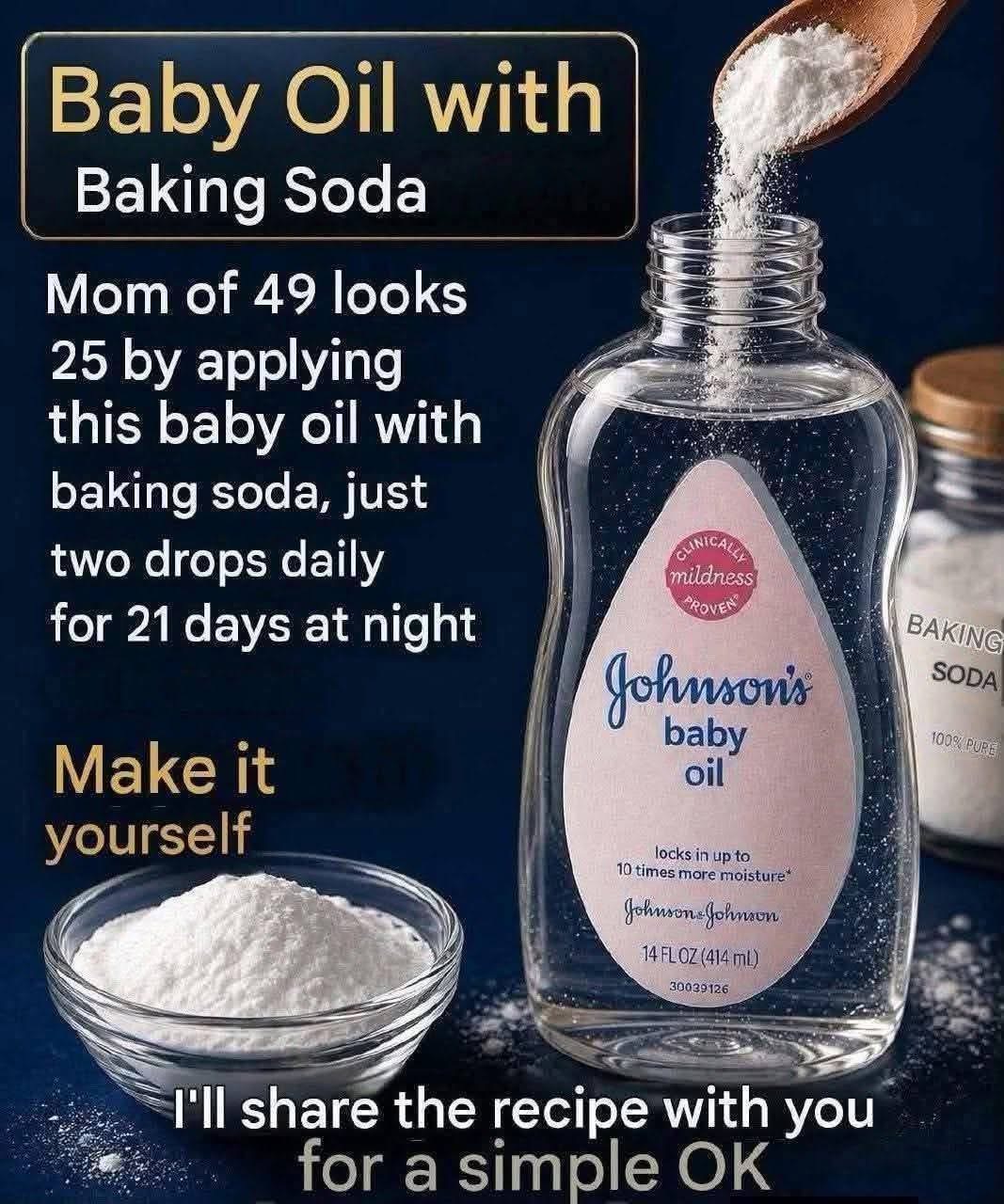
Baby oil is one of those simple products that has been sitting in bathroom cabinets for generations. It feels silky, spreads easily, and can make dry skin look smoother almost immediately.
When combined with a good moisturizer, a tiny amount of baby oil can be especially useful for dry legs, elbows, hands, and other rough areas.
Baking soda is a very different ingredient. Although it appears in many homemade beauty recipes, it is highly alkaline compared with healthy skin and can leave the face dry, tight, irritated, or flaky when used repeatedly.
So instead of mixing baking soda directly into baby oil, there is a gentler way to get the soft-skin effect people are usually looking for.
What Baby Oil Actually Does
Most traditional baby oils are based primarily on mineral oil.
Mineral oil works as an occlusive ingredient. This means it forms a thin layer over the skin and reduces the amount of water that evaporates from its surface.
That is why skin can feel noticeably softer after applying it.
Baby oil may help:
- Reduce a dry, tight feeling
- Make rough areas feel smoother
- Help seal moisture into the skin
- Improve the appearance of dry fine lines temporarily
- Add a soft glow to arms and legs
- Protect dry areas after bathing
It does not actually reverse aging.
The smoother appearance comes largely from better hydration and a more even skin surface.
Can Baby Oil Make Someone Look Years Younger?
Moisturized skin often looks plumper and healthier.
As skin becomes drier with age, fine lines can become more noticeable. Dermatologists recommend regular moisturizing because trapping water in the skin can improve its appearance.
That can make a real cosmetic difference.
But there is no realistic recipe that turns 49-year-old skin into 25-year-old skin in 21 days.
Normal skin aging involves changes in collagen, elastin, pigmentation, moisture retention, and the accumulated effects of sun exposure.
Oil cannot reverse all of those processes.
What it can do is make dry skin feel considerably more comfortable—and sometimes that simple improvement is surprisingly satisfying.
Why Baking Soda Can Be Harsh on the Face
Healthy skin naturally has a mildly acidic surface.
Research has found that higher-pH, alkaline products can disturb the outer skin barrier, while skin conditions are generally better when the surface remains mildly acidic.
Baking soda is alkaline.
Repeatedly rubbing it on the face may contribute to:
- Dryness
- Tightness
- Redness
- Burning
- Flaking
- Increased sensitivity
- Irritation around the eyes
- Worsening of already sensitive skin
The problem can become worse when baking soda is used as a scrub.
Its small particles provide physical friction at the same time that the alkaline mixture is affecting the skin barrier.
The face really does not need to be polished like a kitchen sink.
A Safer Baby Oil Night Routine
If your goal is softer, smoother-looking skin, this routine is much gentler than combining baking soda with oil.
Preparation time: 2 minutes
Use: External only
Best for: Normal to dry skin
What You Need
- A gentle facial cleanser
- A fragrance-free facial moisturizer
- 1 to 2 drops baby oil or plain cosmetic-grade mineral oil
- Lukewarm water
- A clean soft towel
How to Use It
Wash your face gently with lukewarm water and a mild cleanser.
Avoid very hot water.
Pat your skin lightly with the towel, but do not dry it completely.
While the skin is still slightly damp, apply your usual moisturizer.
Let it settle for approximately 30 seconds.
Place one or two drops of baby oil onto clean fingertips.
Rub your fingertips together.
Gently press the oil over the driest parts of your face.
Do not scrub.
Do not apply a thick layer.
One or two drops really are enough. Your face needs a light seal, not an oil change.
Why Moisturizer Should Come First
Baby oil mainly helps prevent water from escaping.
It does not provide all the components of a complete moisturizer.
Applying a moisturizing cream or lotion first gives the skin ingredients that attract and hold moisture.
Adding a tiny amount of oil afterward helps seal that moisture in.
Dermatologists also recommend applying moisturizer while the skin is still damp because this helps trap water in the skin.
This method works especially well after an evening shower.
Simple Body Softening Treatment
Baby oil is often even more useful on the body than on the face.
Ingredients
- 1 tablespoon fragrance-free body moisturizer
- ½ teaspoon baby oil
Instructions
Take a shower using lukewarm rather than very hot water.
Pat your skin lightly until it remains slightly damp.
Mix the moisturizer and baby oil between your palms.
Massage it gently over dry areas such as:
- Legs
- Arms
- Elbows
- Knees
- Heels
Do not apply it to broken or infected skin.
This simple combination helps the moisturizer spread easily while giving dry skin a softer finish.
A Gentle Alternative to Baking Soda Exfoliation
If rough skin is the reason you were interested in baking soda, try a gentler approach.
Oat Body Scrub
You will need:
- 1 tablespoon finely ground oats
- 1 tablespoon fragrance-free moisturizer
- ½ teaspoon baby oil
Mix everything in a small bowl immediately before use.
Apply it to damp elbows, knees, or heels.
Massage with extremely light pressure for about 20 seconds.
Rinse with lukewarm water.
Pat dry and apply moisturizer.
Do not use this scrub around the eyes or on irritated, broken, freshly shaved, or inflamed skin.
And do not store leftovers.
Homemade skincare containing food ingredients does not contain a tested preservative system, so it is better to make only enough for one use.
What Helps Mature Skin Most?
Expensive routines are not always necessary.
For many people, three consistent habits are more useful than a shelf containing fifteen products.
Gentle Cleansing
Use lukewarm water and a mild cleanser.
Avoid aggressive scrubbing.
The American Academy of Dermatology specifically recommends mild cleansing and avoiding scrubbing when caring for skin in the 40s and 50s.
Daily Moisturizer
Apply moisturizer after washing.
Look for ingredients such as:
- Glycerin
- Ceramides
- Hyaluronic acid
- Mineral oil
- Petrolatum
- Squalane
Very dry skin usually benefits more from creams or ointments than thin lotions.
Daily Sunscreen
Sun exposure contributes significantly to visible skin aging.
Dermatologists consider sunscreen and moisturizer two of the most useful basic anti-aging products. A broad-spectrum SPF 30 or higher is generally recommended for exposed skin.
Remember the neck, upper chest, ears, and hands too.
Those areas have a remarkable habit of revealing every sunny afternoon we forgot about.
What About Wrinkles?
Baby oil can make fine dry lines look temporarily softer because well-moisturized skin appears smoother.
It cannot permanently erase wrinkles.
For people who want a stronger anti-aging routine, ingredients such as retinoids may be worth discussing with a dermatologist.
A basic routine might look like:
Morning
- Gentle cleanser
- Moisturizer
- Broad-spectrum SPF 30+
Evening
- Gentle cleanser
- Appropriate treatment product if used
- Moisturizer
- One or two drops of mineral oil over very dry areas
Consistency matters more than adding harsh ingredients.
What About Dark Spots?
Baby oil does not bleach or remove pigmentation.
Baking soda should not be used to scrub dark spots away either.
Dark spots can result from:
- Sun exposure
- Acne
- Hormonal changes
- Skin inflammation
- Injury
- Aging
Daily sunscreen is especially important because ultraviolet exposure can make many forms of pigmentation darker.
Ingredients such as niacinamide, azelaic acid, vitamin C, or professionally recommended retinoids may be more appropriate depending on the cause.
Persistent or rapidly changing pigmentation should be evaluated by a dermatologist.
Patch Testing
Even a simple product can irritate some people.
Before using baby oil widely on the face, place one small drop on the inner arm or another discreet area.
Leave the area alone and watch for irritation over the next day.
Stop using the product if you develop:
- Persistent redness
- Itching
- Burning
- Swelling
- Rash
- Blisters
Fragranced baby oils may be more irritating for sensitive skin.
When possible, choose a fragrance-free mineral oil product.
Areas to Avoid
Never put baby oil or baking soda directly into the eyes.
Avoid rubbing baking soda around the eyelids.
The skin in this area is particularly delicate.
Also avoid DIY mixtures on:
- Sunburn
- Open cuts
- Active eczema
- Rosacea flares
- Infected skin
- Freshly waxed areas
- Irritated acne
- Recently shaved skin
When skin is already angry, adding another experimental ingredient rarely improves its mood.
Can Baby Oil Cause Pimples?
Different skin types react differently.
People with very dry skin may enjoy a tiny amount of mineral oil.
Someone with oily or acne-prone skin may prefer a lightweight moisturizer instead.
If baby oil seems to increase breakouts, stop using it on the face.
You can still use it on dry body areas.
For acne, ingredients specifically formulated for acne—such as salicylic acid, benzoyl peroxide, azelaic acid, or adapalene—are more appropriate than baking soda scrubs.
How Often Can You Use Baby Oil?
For dry body skin, a small amount can be used after bathing whenever needed.
For the face, start with only one or two drops two or three evenings per week.
If your skin remains comfortable, you can adjust according to your needs.
There is no need to follow a strict “21-day” program.
Skin does not know what day of the challenge you are on.
Pay attention to how it feels instead.
Storage
Keep baby oil in its original container whenever possible.
Close the lid tightly.
Store it away from excessive heat and direct sunlight.
Do not pour baking soda, water, lemon juice, herbs, or other homemade ingredients directly into the commercial bottle.
Changing the contents can affect stability and makes contamination harder to control.
Keep baking soda in its own dry container for its normal household and cooking uses.
For homemade skincare mixtures, prepare only enough for immediate application.
Frequently Asked Questions
Can I mix baby oil and baking soda for my face?
It is better to avoid this combination for routine facial skincare.
Baking soda is alkaline and may irritate the skin barrier.
Will baby oil remove wrinkles?
No.
It can moisturize dry skin and temporarily soften the appearance of fine lines, but it does not permanently remove wrinkles.
Can I use baby oil under my eyes?
A fragranced baby oil is not ideal around sensitive eyes.
A fragrance-free facial moisturizer formulated for the eye area is generally a gentler choice.
Can baby oil be used every night?
Some people with dry skin tolerate a tiny amount very well.
Reduce or stop use if you notice breakouts, irritation, itching, or redness.
Does baking soda brighten skin?
There is no need to use baking soda for brightening.
Its irritating effects can actually worsen inflammation and sometimes make uneven pigmentation more noticeable afterward.
What is the easiest anti-aging routine?
A gentle cleanser, moisturizer, and broad-spectrum SPF 30+ create an excellent foundation.
You can add targeted ingredients later according to your skin needs.
Can I use this treatment on my hands?
Yes.
Apply hand cream first and massage one or two drops of baby oil over very dry areas before bed.
Final Thoughts
Baby oil can be wonderfully useful when the goal is simple: helping dry skin feel softer and reducing moisture loss.
Baking soda is better left out of a regular facial routine.
The skin generally responds better to gentle cleansing, a good moisturizer, daily sun protection, and products specifically formulated for skincare.
No two-drop mixture will turn 49 into 25 in three weeks.
But softer, calmer, better-moisturized skin is a realistic goal—and achieving that without making your face sting is a pretty good beauty win.