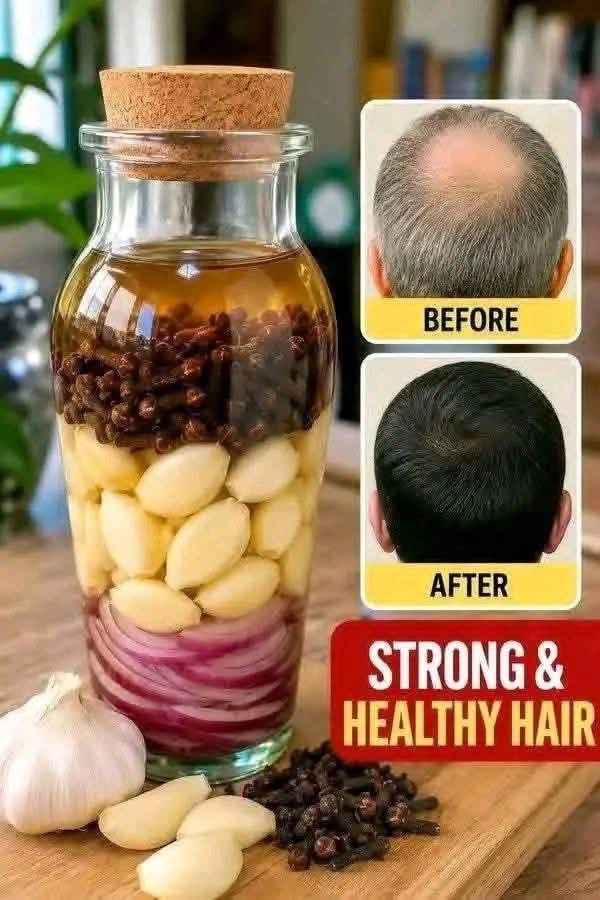
Hair loss posts love big promises.
“Use this one jar and your bald spot will disappear.”
“Before and after in days.”
“Stronger, thicker, shinier hair overnight.”
It sounds exciting, especially when the picture shows onion, garlic, cloves, and a golden oil sitting in a pretty bottle like it came from grandma’s secret shelf.
But let’s keep it real.
This homemade onion hair oil may help your scalp feel nourished, your hair look shinier, and your routine feel more natural.
It will not magically regrow hair for everyone.
Hair loss can happen because of genetics, stress, hormones, iron deficiency, thyroid problems, scalp conditions, medication, aging, or tight hairstyles.
So this recipe is best used as a supportive scalp oil, not a miracle cure.
Still, if your hair is dry, dull, weak, or breaking easily, this natural oil can be a beautiful addition to your weekly routine.
And yes, it smells strong.
Very strong.
Onion and garlic do not enter a room quietly.
Why Onion Is Used for Hair
Onion is popular in traditional hair care because it contains sulfur compounds.
Sulfur is important for keratin, the protein that helps form hair structure.
That is why many people use onion juice or onion-infused oil for scalp care.
But here is the honest part.
Onion oil will not work like a medical hair growth treatment.
It may support the scalp, reduce dryness, and help the hair look healthier, but results depend on the cause of hair thinning.
If your hair loss is genetic or hormonal, a homemade oil alone probably will not fix it.
If your hair is breaking because it is dry, over-washed, heat-damaged, or chemically treated, this oil may help it feel softer and stronger over time.
Why Garlic Is Added
Garlic is another strong ingredient in old-fashioned hair remedies.
It is often used because people believe it supports the scalp and helps with weak hair.
In this recipe, garlic is infused into the oil, not applied directly as a harsh paste.
That matters.
Raw garlic can irritate the skin badly if used too strongly.
Your scalp is skin.
Not a frying pan.
So we keep the garlic gentle and diluted in oil.
Why Cloves Are Included
Cloves add a warm, spicy aroma and are often used in hair oils.
They are very strong, so you only need a small amount.
Too many cloves can make the oil irritating.
The goal is a balanced infusion.
Not a potion that makes your scalp feel like it joined a fire festival.
Ingredients
You will need:
1 small red onion, sliced
5 garlic cloves, peeled and lightly crushed
1 tablespoon whole cloves
½ cup coconut oil
½ cup olive oil
1 tablespoon castor oil, optional
1 teaspoon vitamin E oil, optional
A clean glass jar or bottle
The castor oil is optional, but many people like it because it gives the oil a thicker texture.
Vitamin E oil is also optional and helps preserve the oil a little better while adding richness.
How To Make Onion Hair Oil
Slice the onion into thin pieces.
Peel and lightly crush the garlic cloves.
Add the coconut oil and olive oil to a small pan.
Keep the heat very low.
Add the onion slices, garlic, and whole cloves.
Let everything warm gently for 10 to 15 minutes.
Do not fry the ingredients.
Do not let them burn.
You only want the oil to become infused with the onion, garlic, and cloves.
When the onion becomes slightly soft and the oil smells strong, turn off the heat.
Let the mixture cool completely.
Strain the oil through a fine strainer or clean cloth.
Pour the oil into a clean glass bottle or jar.
Add castor oil and vitamin E oil if using.
Shake gently.
Your onion hair oil is ready.
How To Use It
Apply the oil to your scalp before washing your hair.
Part your hair into sections.
Use your fingers to massage a small amount into the scalp.
Massage gently for 3 to 5 minutes.
Do not scratch.
Do not rub aggressively.
After massaging the scalp, apply a little oil to the lengths and ends of your hair if they are dry.
Leave it on for 30 minutes to 1 hour.
Then wash your hair with shampoo.
You may need to shampoo twice because this oil is rich.
Use once or twice per week.
More is not always better.
Sometimes more just means your pillow smells like dinner.
Overnight Use
You can leave it overnight only if your scalp tolerates it well.
But for many people, 30 minutes to 1 hour is enough.
Because onion and garlic are strong, it is better to start with a short time first.
If there is no itching, burning, redness, or irritation, you can slowly increase the time.
Always listen to your scalp.
A burning scalp is not “the remedy working.”
It is your skin asking you to stop.
What Results Can You Expect?
With regular use, this oil may help your hair feel:
Softer
Shinier
Less dry
More manageable
Less frizzy
Stronger-looking
If your scalp is dry, the oil may make it feel more comfortable.
If your hair breaks easily, oiling can help protect the strands and reduce dryness-related breakage.
But visible hair growth takes time.
Hair does not grow overnight.
Even healthy hair growth is slow.
So be patient and realistic.
This is a routine, not a magic switch.
Best Tips For Better Results
Use the oil consistently once or twice weekly.
Avoid using too much heat on your hair.
Do not brush wet hair aggressively.
Use a gentle shampoo.
Eat enough protein.
Drink water.
Avoid very tight hairstyles.
Sleep well.
Reduce stress when possible.
Trim damaged ends when needed.
Hair health comes from the scalp, the hair shaft, and the body.
A homemade oil can help, but it cannot do everything alone.
Even the strongest onion has limits.
Who Should Avoid This Recipe?
Avoid this oil if you have a sensitive scalp, eczema, psoriasis, scalp wounds, infection, open cuts, or allergy to onion, garlic, cloves, coconut oil, or olive oil.
Do not use it on children without professional guidance.
Do not apply it right after chemical treatments, bleaching, relaxing, or coloring if your scalp feels irritated.
Do a patch test first.
Apply a tiny amount behind your ear or on your inner arm.
Wait 24 hours.
If you notice redness, itching, swelling, burning, or rash, do not use it.
Natural does not mean safe for everyone.
Your scalp has the right to be picky.
How To Reduce The Smell
Let’s be honest.
This oil smells strong.
To reduce the smell, wash your hair well after use.
You can rinse with diluted apple cider vinegar after shampooing, but avoid it if your scalp is sensitive.
You can also add a few drops of rosemary essential oil or lavender essential oil to the finished oil, but only if you tolerate essential oils well.
Use very little.
Essential oils are powerful and can irritate the scalp when overused.
Another trick is to use the oil on a day when you are not going out.
Because onion hair oil is not exactly first-date perfume.
Storage Tips
Store the oil in a clean glass jar.
Keep it in a cool, dark place.
Use it within 2 to 3 weeks.
If you want it to last longer, store it in the refrigerator.
Always use clean hands or a clean spoon.
If the oil smells rotten, changes color badly, or grows mold, throw it away.
Homemade oil should smell strong, but not spoiled.
There is a difference between “onion remedy” and “science experiment.”
Simple Version Without Garlic
If garlic feels too strong, make a gentler version.
Use:
1 small onion
1 tablespoon cloves
½ cup coconut oil
½ cup olive oil
This version is easier for sensitive scalps and still gives you a nice herbal onion oil.
You can also skip cloves if your scalp reacts easily.
Simple is often better.
Final Thoughts
Onion hair oil is a strong, old-fashioned homemade recipe for scalp and hair care.
It may help dry hair look shinier, softer, and healthier.
It may support the scalp when used gently and consistently.
But it should not be promoted as a guaranteed cure for baldness or serious hair loss.
If you have sudden hair loss, bald patches, scalp pain, severe dandruff, itching, or fast thinning, it is better to speak with a dermatologist.
A homemade oil can support your routine.
It cannot replace proper diagnosis.
Use this recipe with patience.
Use it gently.
Wash it well.
And remember: healthy hair is not built from one viral jar.
It comes from care, consistency, nutrition, and a scalp that is not being attacked by too many experiments.